SlopeShift · Classroom kit · Ages 14+
Build a wind logger, then forecast the wind
SlopeShift is a kit for high-school science and engineering classes. Students build a wind vane and anemometer that log every minute for about 20 days. Then they find when the wind turned each morning and evening, and learn to forecast it from the sun.
In development. The firmware is written, tested on a PC and compiles for the board. The analysis tools work on made-up demo data. No unit has been built and run outdoors yet, so we're not quoting accuracy figures. If you'd like to pilot a kit with a class, get in touch.
What students do
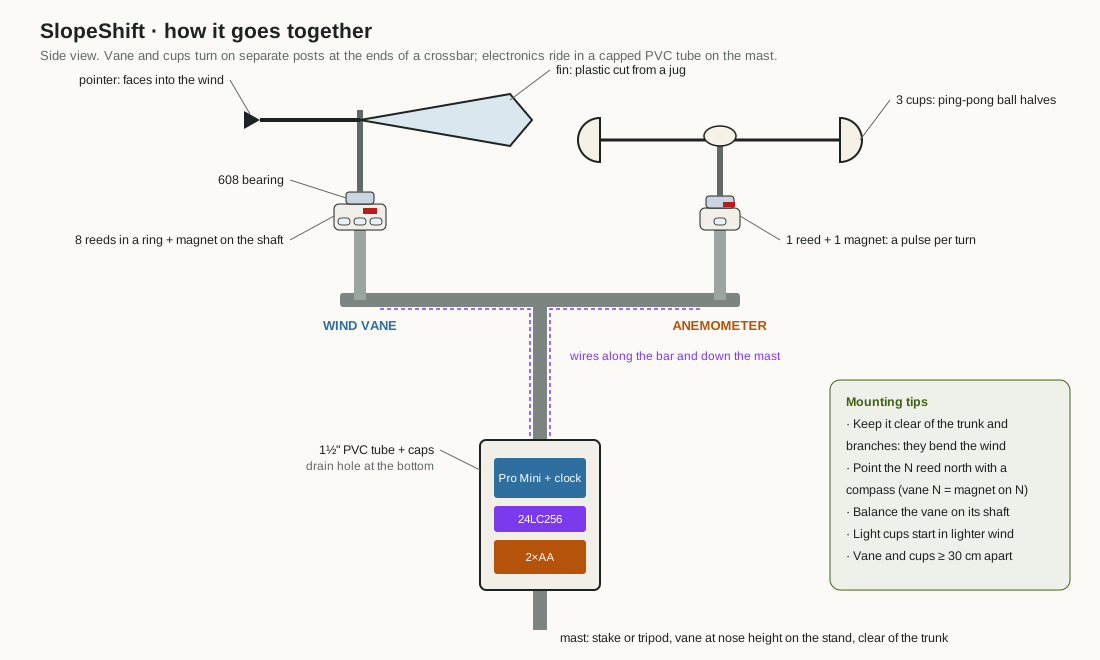
- Build it. Solder a reed-switch vane and resistor ladder, fit the cups and magnet, and seal the electronics in a PVC tube. Two or three class periods.
- Log real wind. Set the clock, calibrate the cups, and leave it outside for one to two weeks. It records direction and speed every minute.
- Find the switch. Load the log in the Analyzer. On calm, clear days, local winds turn around each morning and evening. Students see when, and on which days the weather overrode it.
- Forecast it. Describe the site (slope, the direction it faces, any ridges) and the Analyzer learns how the switch follows the sun. Students predict the switch for dates they haven't measured, then test the predictions against new data.
Schoolyards are often flat, and flat ground gets weak slope winds. Near a lake or the sea, students can log the lake or sea breeze instead: the Analyzer has a shore setting for it. For a quick demo in class, the logger's fast mode prints a reading every 2 seconds and flags the switch when you turn a fan or hairdryer around.
What's in the box
- Electronics: Pro Mini 3.3 V board with the firmware already loaded, DS3231 clock with coin cell, 24LC256 memory chip and socket, perfboard and headers.
- Sensors: 9 glass reed switches plus spares, 1% ladder resistors, a capacitor, and small neodymium magnets.
- Mechanical: bearings, bolts, PVC tube and caps, crossbar, cable, a 2×AA holder with switch, and fittings.
- Printed parts: vane, hub, reed ring, cup rotor, clamps and mast bracket.
- Cable: a 3.3 V USB-serial adapter for setting it up and reading the log. Classroom packs share three.
You also need: 2 AA batteries, a stake or pole, a soldering iron and solder, wire cutters, a compass, and a computer with a web browser.
Options
Single kit
One logger kit and a USB-serial adapter. For a teacher trying it out, a student project or a science fair.
Classroom 10-pack
Ten logger kits for a class working in pairs or threes, three shared adapters, a spares bag, and the printed teacher guide.
Assembled unit
Built, tested and calibrated, for a demo beside a class set. Available once units have been tested outdoors.
Prices aren't set yet. Ask for a classroom quote and tell us your class size and when you'd like to start.
What students learn
The teacher guide has five lessons, each with a student worksheet and an answer key:
- Why slopes make wind. Heating, cooling and air density; why the wind turns around twice a day.
- Sensors. Reed switches, the resistor ladder, and the maths that turns one analog reading into 16 directions.
- Build and deploy. Assembly, calibration, and choosing a good spot.
- Data. Why you can't average directions like ordinary numbers, and how to find the switch in a noisy log.
- Model and predict. The sun's path and sun on a slope; make predictions, then test them against new data.
It fits Earth science, physics and engineering design units. We're still checking it against specific standards and provincial curricula.
The Analyzer
The SlopeShift Analyzer runs in a web browser, with nothing to install and no student accounts. The log stays on the student's computer. It shows each day's switch, wind by time of day, and a forecast for any dates you choose. You can try it now with two weeks of demo data (made up, for practice).
Specs
| Direction | 16 points, from 8 reed switches on one analog pin |
|---|---|
| Speed | Cup anemometer, one pulse per turn; calibrated by the class |
| Records | Direction and speed once a minute, about 20 days per memory chip |
| Clock | DS3231 with coin-cell backup |
| Power | 2×AA; sleeps between readings |
| Board | Pro Mini 3.3 V, 8 MHz |
| Data | CSV over USB-serial; Analyzer in the browser, plus command-line tools |
| Ages | 14+ with a teacher. Contains small magnets. |
Want the details? The assembly guide covers every step, and the SlopeShift article explains the science and the design.
How it compares
Classroom weather and wind kits we found cost roughly $220 to $250. Some are one calibrated sensor for a whole class, and some are paper-plate builds that don't record anything. SlopeShift gives each group its own logger, and the data work keeps going after the build. A calibrated commercial sensor is the better instrument, and SlopeShift's readings depend on how carefully students build and calibrate it. We couldn't find a classroom kit where students forecast their own site's wind from the sun.
⚠ WARNING: magnets. This kit contains small, strong magnets. If two or more are swallowed, they can pull together inside the intestines and cause serious injury or death. Get medical help right away if a magnet is swallowed. Not for children under 14. Keep loose magnets away from young children.
⚠ MISE EN GARDE : aimants. Cette trousse contient de petits aimants puissants. Si deux aimants ou plus sont avalés, ils peuvent s'attirer l'un l'autre dans l'intestin et causer des blessures graves ou la mort. Consultez immédiatement un médecin si un aimant est avalé. Ne convient pas aux enfants de moins de 14 ans. Gardez les aimants hors de la portée des jeunes enfants.
Classroom quotes
Teachers and schools: contact ZalaStack with your class size, grade, and when you'd like to run it. We're also looking for a few classes to pilot the first kits.